

The Research and impact strategy focuses on developing a progressive dietetic workforce by strengthening research culture and capability, and increasing the visibility of dietetic impact beyond the profession. It spans all careers stages, employment sectors, job roles and geographical locations.
Using and generating evidence are essential to improving outcomes for service users, populations, and health and care systems. By embracing a more inclusive view of research, the strategy reinforces that research is everyone’s business.
Aims and objectives

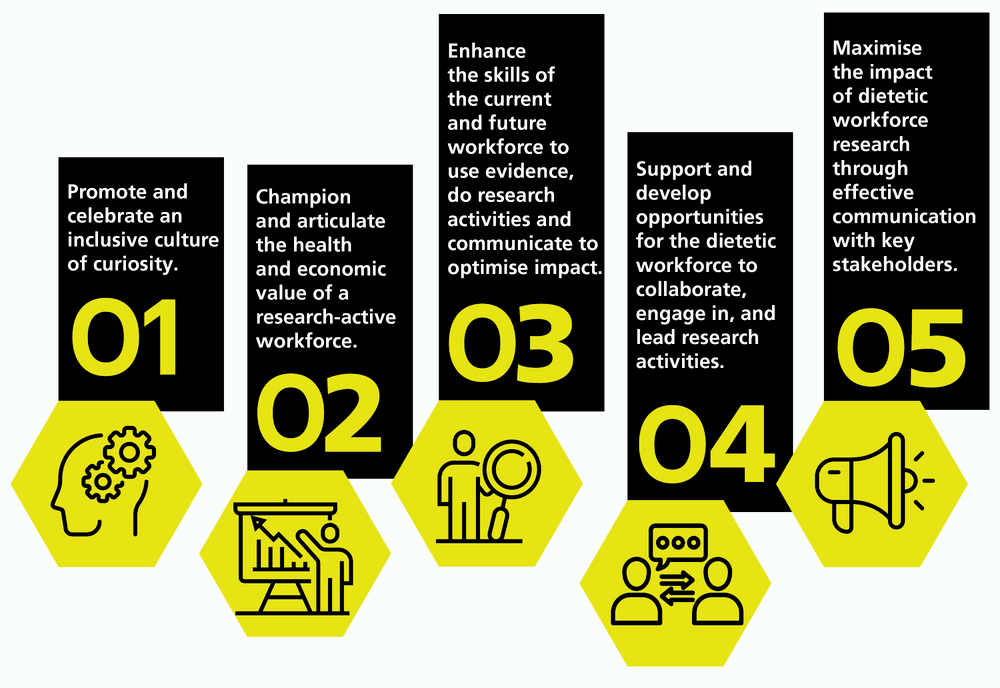
1. Promote and celebrate an inclusive culture of curiosity to inspire greater engagement and a sense of belonging in research by the whole dietetic workforce
a. Increase visibility of the range of research activities undertaken across the diverse dietetic workforce.
b. Raise the profile of projects that demonstrate the positive impact of dietetic workforce interventions.
c. Celebrate successes in research activities and research leadership across all career stages, employment sectors and job roles.
2. Champion and articulate the health and economic value of a research-active workforce to managers, employers and healthcare leaders
a. Raise the profile of projects that demonstrate the value of a research-active dietetic workforce.
b. Support managers, employers and leaders to embed research activities into roles and routine practice for the whole dietetic workforce, across all career stages.
c. Support and promote research activities that evidence the impact of practitioner and clinical academic roles.
d. Celebrate and provide recognition where research-active environments are evident.


3. Enhance the skills of the current and future workforce to use evidence, do research activities and communicate to optimise impact
a. Support members to critically engage with evidence-based practice.
b. Ensure research skills and their practical application are prominent within training the future workforce.
c. Provide guidance for doing effective, culturally competent, co-produced research activities with public and service user involvement; from idea generation, to project completion and knowledge mobilisation.
d. Create a sustainable mentorship scheme that is inclusive, supportive and rewarding for mentors and mentees.
e. Provide guidance to maximise the impact and knowledge implementation from research activities.
4. Support and develop opportunities for the dietetic workforce to collaborate, engage in, and lead research activities to expand the UK dietetic research capacity.
a. Optimise and create effective, supportive and sustainable networks to facilitate collaboration.
b. Develop BDA research priorities to inform multi-centred projects to produce high quality dietetic outcomes data, identify and address inequalities, and evidence for dietetic workforce impact.
c. Improve visibility of research funding opportunities for the dietetic workforce.
d. Promote research leadership training and opportunities to the dietetic workforce.


5. Maximise the impact of dietetic workforce research through effective communication with key stakeholders.
a. Raise the profile of impactful dietetic workforce research activities beyond the UK dietetic profession.
b. Optimise dietetic impact through effective communication of evidence informed BDA research activities and policy to key stakeholders.
c. Increase dietetic representation and influence within key research stakeholders and within AHP research communities.
Access the strategy
You can access a PDF version of the strategy which you can download and print, by clicking the image below:
Approach to development
The Strategy was informed by published literature including healthcare research strategies for England, Wales, Scotland and Northern Ireland 1-5.
The strategy has been informed by engagement with:
- Specialist group research officers and dietitian research networks.
- Wider membership engagement via open questions within an online survey.
- The 2025 Academy of Nutritional Sciences survey: Responses to the barriers and motivators for doing research (n=583 dietitians).
- BDA Country Board Chairs, BDA Professional Committee and BDA Equality, Diversity and Inclusion Committee.
The strategy received formal approval and full endorsement from the BDA Board of Directors.
Useful links



References:
- Department of Health (2023) Allied Health Professions’ Research and Innovation Strategy Northern Ireland.
- Chief Allied Health Professions Officer (England) report (2025) Allied Health Professions (AHP) Evidence Informed Policy: Research Priorities. Consensus Agreement.
- NHS England Report (2022) Allied Health Professions’ Research and Innovation Strategy for England
- Scottish Government (2023) Allied Health Professions Education and Workforce Policy Review Recommendations: Research, Innovation and Relationships.
- Welsh Government (2025) Strategic action plan for building research capability for nursing, midwifery and allied health professions in Wales.