

Food insecurity affects health, wellbeing and people’s ability to follow dietetic advice. It is something many members will already be seeing in practice. That is why we are encouraging members to consider submitting evidence to the Right to Food UK Commission.
The Commission is gathering evidence from across the UK on the scale and causes of food insecurity, its impact on public health, and the policy changes needed to address it. It was formally launched in Parliament on 17 November 2025 and has already held evidence sessions in Liverpool, Newcastle, Belfast, Glasgow, Cardiff and London.
This is an important opportunity for the profession. Dietitians understand how food insecurity affects people across the life course. We see the impact on nutritional intake, long term health, recovery, child health and people’s ability to act on dietetic advice. Members working in the NHS, public health, education, community settings, research, social care and the voluntary sector may all have valuable evidence to contribute. The Commission is also interested in lived experience and wider community perspectives.
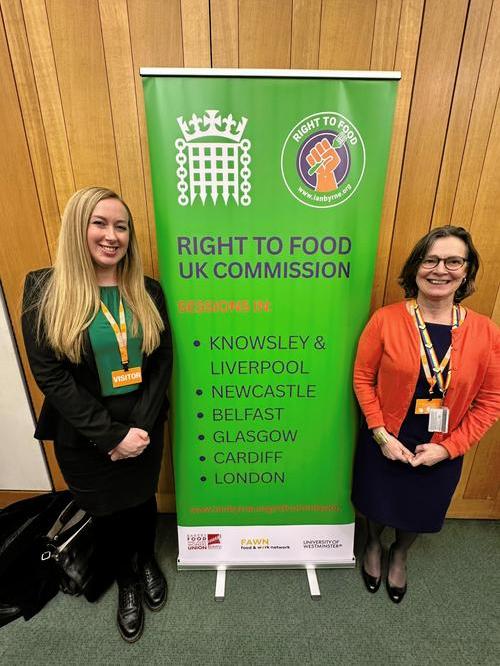
From left to right: Abby Pearson, Senior Specialist Dietitian in the NHS, Project Manager for Right To Food London and BDA London Branch Committee Member and Dr. Sharon Noonan-Gunning, Right to Food Commissioner and Co-chair, London Branch
The Right to Food UK Commission has been established jointly by the Right to Food Campaign, the University of Westminster, the Bakers, Food and Allied Workers Union and the Food and Work Network. Its work includes looking at the extent and nature of food insecurity across the UK, the effects of malnutrition and food insecurity on public health outcomes, the impact of labour market and welfare pressures, the role of public policy, support for community based food initiatives, and how an effective and enforceable Right to Food could work in law.
These issues matter to the British Dietetic Association (BDA) and to our wider member community. There are clear links with work on food strategy, public health, inequality and access to nutritious food. This article was proposed internally as a way to raise awareness of the Commission and encourage members to get involved, with supporting social media activity to follow.
Abby Pearson, Senior Specialist Dietitian in the NHS, Project Manager for Right To Food London and BDA London Branch Committee Member, said:
“Supporting the Right to Food UK Commission is vital for dietitians because food insecurity affects our work across all professional settings. To dismantle the significant systemic barriers that drive food insecurity and unsustainable food systems, a cross-party parliamentary approach is needed to put sufficient pressure on the government to take accountable action. The Commission’s five demands reflect many of the BDA’s campaign priorities, including extending free school meals to all primary school children, developing a comprehensive UK Food Strategy, and strengthening the dietetic workforce. We can help make this a reality by sharing the Commission’s work and submitting evidence.”
Alex Ehrlich, Public Affairs Officer at the BDA, said:
“Dietitians see every day how food insecurity affects health, recovery and long term outcomes. For the BDA, this matters not only because of the impact on individuals and communities, but because it highlights the need for a more joined up approach to food policy, prevention and access to a healthy diet. This Commission is an important opportunity to ensure the profession’s evidence and practical experience help shape solutions that are fair, practical and effective.”
The Commission is inviting written evidence on a wide range of issues. These include food insecurity in the UK, experiences of seeking support for food, the impact of free school meals, the impact of community kitchens, the role of social protection and income support, the importance of a living wage, the effect of policy on people’s ability to feed themselves and their communities, and how a Right to Food law could work in practice. It is also inviting people with lived experience of food insecurity to share their views through its Community Voices route.
Members who want to contribute should read the call for evidence carefully before submitting. The Commission says submissions should be concise. If a submission is more than 3,000 words, it should include a short summary. The uploaded file should be a single Word document, under 10MB, and contain no logos.
The deadline for submissions is 5pm on 30 May 2026. Any evidence received after that point will not be considered for inclusion in the report, so we encourage members who wish to contribute to do so as soon as possible and to encourage colleagues to get involved too.
To submit evidence, visit the Right to Food UK Commission evidence submission form.