

As the 7th Edition of the Manual of Dietetic Practice is launched, the editing team reflect on the long process of getting it to publication.
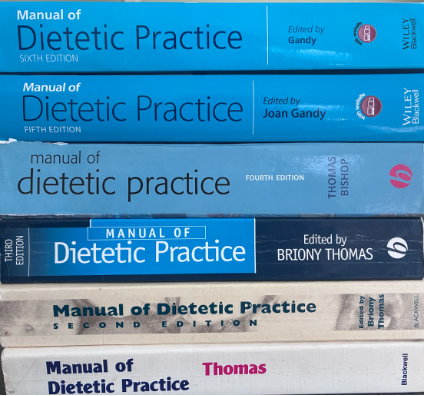
The Manual of Dietetic Practice is a book that almost every dietitian has seen, used, loved and, at times, even hated. Over the past 40 years, almost every dietitian who has trained in the UK will probably have developed these types of memories.
Our memories could be fond ones, reminiscing of student days, or more challenging ones of trying to cram as much of the 750 to 1,000 pages (depending on which version you used) into your memory for exams.
Whatever our memories may be, it has undoubtedly been part of our journey as we trained and then practised as dietitians. Now, along with more than 260 amazing authors, we are about to become part of the journey of the next generation of dietetic learners.
The 7th Edition of the Manual of Dietetic Practice was published on 22 May - around the same time as Dietitians Week 2026. So, in the year the British Dietetic Association celebrates serving the profession for 90 years, it is a good time to look back at what we have achieved as a profession and as individuals, as well as look forward to the future.
Planning and editing a textbook such as the Manual of Dietetic Practice provides you with the ideal lens to explore the complexity and breadth of our profession, how it has developed its identity and evidence base, and how it might continue to evolve in the future.
When we started our journey together, the team was a little different, with Professor Gary Frost part of the original group. Unfortunately for us as an editorial group – but fortunately for Gary – he was successful with some very large research grants and was no longer able to continue as part of the team of editors. At this point, we needed another team member, all being busy with full-time roles in academia and healthcare.
Fortunately, Dr Adrian Brown came on board, having already been heavily involved in obesity chapters. The team of editors has remained involved for the rest of the development of the book. But a lot happens in personal and professional lives over a period of two years. The strength of our team has been in sharing work to help balance all our work and life commitments, and this has allowed us to successfully bring the 7th Edition of the Manual of Dietetic Practice to publication.
Before we started in 2023 (yes, that is how long it takes to bring a textbook covering the breadth of practice in dietetics together), we thought it was important to reflect on what a modern textbook needs. Since the last edition, in 2019, it’s fair to say the world has changed.
Things that are normal now, including online learning and remote working, were rare back then. So, we undertook a survey of the profession, which received nearly 1,200 responses, asking what it wanted from this new edition of the Manual.1
The results of the survey suggested practising dietitians wanted more clinical information, whereas students wanted more summaries. The challenges of the cost of the textbook and its size were clear, as were the difficulties of keeping it up to date. New topics came through, including requests to cover avoidant restrictive food intake disorder (ARFID), sustainability, fertility and long Covid. There was also a desire to keep the familiar and trusted physical copy alongside a more dynamic and accessible digital version.
This detailed information was core to how we planned this edition of the Manual – we sought to include summaries for each chapter, where possible aligning it with the principles of the Model and Process for Nutrition and Dietetic Practice.2 This approach was chosen to support readers, using chapter summaries, along with a series of chapters that summarise the principles of this process. This structure not only reflects how dietetics is taught in higher education but also supports practising dietitians who supervise learners who may be less familiar with this approach to dietetic practice.
This has resulted in the book being structured into six thematic parts, from foundation skills through to advanced clinical interventions. These thematic parts are:
- Professional Practice – this includes new chapters on advancing practice and personalised nutrition
- Public Health and Food Provision – this has expanded information covering this key area, including food systems, global dietary cultures and sustainable diets
- Nutrition Through the Lifecycle – this is a new section for this edition, covering fertility and preconception, pregnancy, postpartum, menopause, childhood, adolescence and neurodiversity
- Assessment, Diagnosis and Interventional Strategies – this is new for the 7th Edition. This section is aligned to the Model and Process for Nutrition and Dietetic Practice, and includes core topics, including dietetic diagnosis and texture-modified diets
- Adult Clinical Practice – this section has been fully updated and reorganised to reflect current best practice and evidence. New chapters have been included on frailty, multimorbidity and personalised cancer care
- Paediatric Clinical – this features new content on ARFID and structured clinical guidance. This is not designed to be the core resource for paediatric dietitians, but it supports students and dietitians who need an introduction to paediatrics and a place to start before moving to more detailed specialist paediatric resources
The need to include new topics and a new approach created a problem of space. A hardbound book can typically have around only 1,000 pages before a second volume is required. This would have made the physical version even less practical than the previous versions.

This is Mary Hickson reading her copy of the 1st Edition of the Manual of Dietetic Practice while revising for the Australian dietetic registration exam in 1991!
If you still have a copy of your Manual from when you were studying – or the one you identify with from when you came into practice – help us celebrate Dietitians Week and the release of the 7th Edition by sharing a picture of yourself holding it, either today or from your past!
This did mean some challenging decisions had to be made. Previous editions were extensively referenced by their expert authors, but we decided pragmatically to limit references to about 30 that were key if the reader needed to know more.
The next stage was to contact authors to help build the book. We anticipated this would be challenging, as we had experienced ourselves. The Manual is important, but it has to be balanced with demanding workloads. We recognised we were asking a great deal, so we were especially grateful for the positive response. Authors agreed to contribute, recognising the Manual’s central role in our profession. Throughout 2024 and 2025, chapters were steadily submitted and edited, with authors generously giving their time to make this work possible.
Once the chapters were in, there was the challenge of ordering chapter headings and subheadings. This might not sound important, but it is a key part of the next stage and next generation of textbooks. Part of the development of this version of the Manual was to make it suitable as a Major Reference Work (online textbook format). This careful tagging allows for more refined searching of content for the online version of the book.
This will move from an online experience akin to reading a page on a screen to one where you can search for parts of articles, making accessing the key information far more efficient. The other key benefit of a Major Reference Work is that, as topics change in the future, revisions can be made rather than waiting for the next edition.
To celebrate the impending publication, all the editors met in London to reflect, eat, drink and rejoice – our task was at an end! It has been a long journey and, unlike some aspects of dietetic practice, textbook writing does not pay well. We are so thankful for the time and help so many expert authors have given us to produce this edition. These authors, like us, are motivated to support the profession, seeing it as an honour to be able to make a lasting contribution to the future of dietetics.
So, what next? Will there be an 8th Edition of the Manual of Dietetic Practice? It’s possibly too early to say, but we hope so. It is likely to be very different, with a greater online presence, but still, hopefully, keeping some form of physical version, as many of us value and trust its encyclopaedic value on our shelves.
Ultimately, we would want to see the Manual of Dietetic Practice continue to be up to date, valued, and the ‘go-to’ general resource for dietetic learners and practitioners. It has never been intended to provide complete answers to all our questions, but rather a starting point – a guide to steer us in the right direction as we continue to develop as evidence-based and effective dietitians.
As we celebrate Dietitians Week 2026, a year that celebrates 90 years of the British Dietetic Association serving the dietetic workforce, we are proud to share how the Manual of Dietetic Practice has been part of that. We are part of that history, service and development, too – truly a case of ‘standing on the shoulders of giants’. So, we would like to thank all the dietitians who have supported this, as well as the previous editions.
Of course, this would not have been possible without the hard work of the previous editors, Briony Thomas, who edited the first four (the last one with Jacki Bishop), and Joan Gandy.
An accompanying Editorial has been published in the Journal of Human Nutrition and Dietetics to celebrate how dietetic research informs dietetic practice and the 7th Edition of the Manual of Dietetic Practice.
Medicines management and prescribing chapter highlights developing profession
As the BDA marks its 90th anniversary, it is an opportune moment to reflect on the profession’s journey, particularly its evolving role in prescribing.
From early efforts to establish dietetics as a regulated, evidence-based discipline, to more recent advances in obtaining supplementary prescribing rights in 2016 and the ongoing campaign for independent prescribing rights, the BDA has consistently championed the development of dietitians. This milestone year not only celebrates that legacy, but also sets the stage for the next phase of practice.
Whether you’re a supplementary prescriber or not, a solid foundation in understanding the principles of prescribing is increasingly recognised as integral to delivering high-quality, person-centred nutritional care.
The launch of the 7th Edition of the Manual of Dietetic Practice introduces a timely and significant new chapter focused on medicines management and prescribing governance. Importantly, the chapter makes clear that prescribing principles are relevant not only to dietitians with supplementary prescribing rights but also to all dietitians involved in requesting, recommending or reviewing Nutrition Borderline Substances (NBS) as part of patient care. As prescribing becomes more embedded within the profession, the chapter aligns closely with established frameworks, including those set out by the Health and Care Professions Council (HCPC) and the Royal Pharmaceutical Society (RPS).
Drawing on these recognised standards, the chapter provides practical, structured guidance to support safe, effective and person-centred prescribing. It highlights key themes such as accountability, clinical reasoning, shared decision-making, and ongoing monitoring and deprescribing – principles that underpin high-quality care and are central to both HCPC expectations and the RPS competency framework for prescribers.
The chapter emphasises that these principles should underpin all NBS‑related decision-making, regardless of whether the dietitian is acting as a prescriber or requesting a prescription to be issued by an independent prescriber. Set for publication in June, the updated Manual will be accompanied by a series of webinars, delivered by the Optimising Nutrition Prescribing Specialist Group (ONPSG), aimed at supporting implementation of these principles across the profession. These sessions will offer opportunities to explore how essential prescribing principles translate into everyday practice, with case-based discussions and peer learning designed to build confidence across a range of clinical contexts.
In parallel, the BDA Professional Practice Team is developing a position paper, in conjunction with specialist groups, aimed at highlighting the importance of the application of prescribing principles when working with NBS. This remains a nuanced area of practice, requiring careful consideration of clinical need, patient outcomes and responsible resource use.
The forthcoming paper will aim to provide clarity and consistency, supporting dietitians to apply prescribing principles in a way that is both evidence-informed and professionally robust, regardless of dietitians’ prescribing rights.
Together, these initiatives underscore a pivotal moment for the profession – strengthening the role of dietitians in both prescribing and medicines optimisation and reinforcing the frameworks that support safe, effective and accountable practice.
Sian Cunningham, Professional Practice Manager at the BDA, and Heather Nunn, Alison Smith and Monica Compton, from the BDA Optimising Nutrition Prescribing Specialist Group
References
- Wedlake L, Mellor D, Marriott T, et al. (2024) What do readers want? Results of an online survey to involve readers in updating the seventh edition of the Manual of dietetic practice. J. Hum.Nutr. Diet. 37(1): 280–291.
- BDA (2021) Model and Process for Nutrition and Dietetic Practice [Online] Accessed 6 April 2026. Available at: model-and-process-for-dietetic-practice.html