

This part covers the method of giving a blend, rate, posture and the choice between a syringe method and a pump delivery.
1. Use a slow plunge method to give a thicker blend
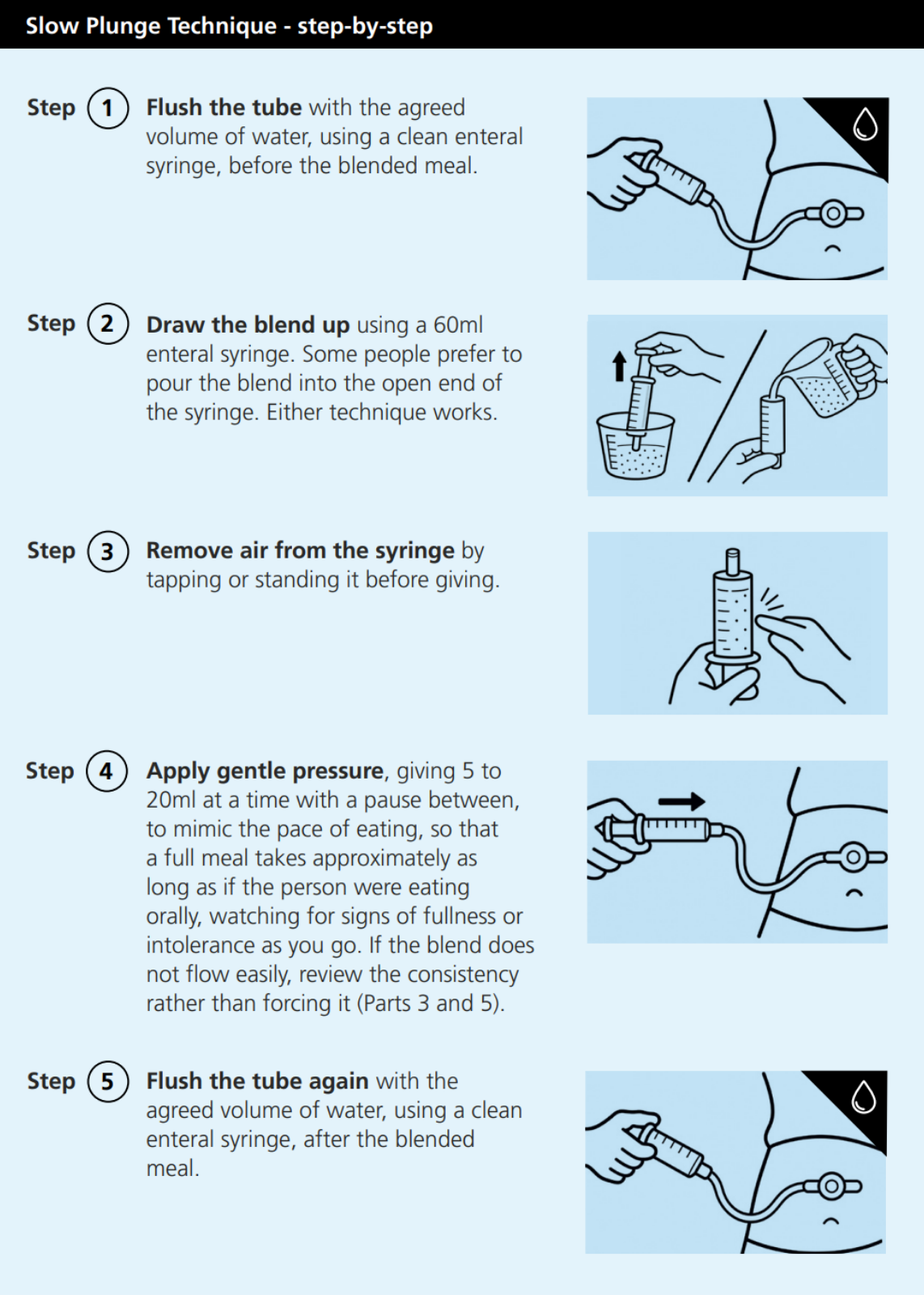
A slow plunge method is the usual method, and it allows a thicker blend to be given.
A gravity bolus can only be used with a thinner blend and has a much slower flow rate with ENFit connections.
Thinning reduces both viscosity and nutrient density, and a higher viscosity is thought to be one reason for the positive effect on reflux, retching and vomiting symptoms.
Sieving removes lumps, and gentle warming helps reduce viscosity and ease flow. Use these instead of thinning the blend with added liquid (Part 3).
2. Give the blend in small amounts, at the pace of a meal
Use a 60ml enteral syringe. Some people prefer to draw the blend up, saying it allows lumps to be seen. Others prefer to pour the blend into the open end of the syringe, or to draw it from a feeding bottle through an enteral adaptor.
Any of these methods works, and the choice is a matter of personal preference.
Remove air from the syringe by tapping or standing it before giving. Apply gentle pressure, giving 5 to 20ml at a time with a pause between, to mimic the pace of eating, so that a full meal takes approximately as long as if the person were eating orally, watching for signs of fullness or intolerance as you go.
If the blend does not flow easily, review the consistency rather than forcing it (Parts 3 and 5). Flush the tube with the agreed volume of water, using a clean enteral syringe, before and after the blended meal rather than between each syringe. Repetitive strain injury has been reported in parents and carers using this method (Part 4).
3. Set the rate for the individual; there is no standard rate
Tolerance varies between people, so a rate for a given volume cannot be applied universally, even within an age range or condition.
Start slowly and build with the person, introducing one change at a time and allowing enough time to assess the response before adjusting further, watching for the symptoms in Part 10.
Tolerance also varies for the same person from day to day, as it does with oral eating, and is often lower during illness, so the plan should allow the rate to be slowed when it needs to be.
4. Consider a pump where the slow plunge method is not possible
Pumps designed for blends now exist in the UK market, and a pump is an option where the slow plunge method is not possible or not tolerated.
Not all pumps and giving sets are designed for use with blends.
Check the manufacturer’s instructions for use and advice on blend consistency.
A blend should not be at room temperature for more than two hours, so it is given as a slow bolus by pump rather than as a continuous feed.
Some dietitians have been able to access these pumps and extension sets using personal health budgets.
5. Consider posture and positioning during administration
Position the person safely and comfortably throughout and watch how they tolerate it. This matters particularly where a blend is given more slowly or by pump, when the person may be in one position for longer.
Involve the family and the carers who know the person well, since they will recognise what is usual for them.
| Method | What it offers | What to consider |
|---|---|---|
| Slow Plunge Technique | Allows administration of a thicker blend, which allows maintenance of nutrient density as additional fluid is usually not required. The higher viscosity may help improve symptoms and gives greater control over pace and volume given. |
Requires active involvement of parent/carer and has a risk of repetitive strain injury. The Blend consistency must be prepared appropriately to flow safely. |
| Pump-Assisted Blended Diet Feeding | Useful when slow plunge feeding is not possible or not tolerated which can support people requiring slower administration. It reduces physical burden on carers and can provide a more consistent delivery rate. |
Not all pumps and giving sets are suitable for blended feeds. Equipment may not be readily available and can require funding arrangements. Feeds should not remain at room temperature for more than 2 hours. |
| Gravity Bolus Feeding | Less manual effort than slow plunge feeding. It can be convenient for some families. | Requires a thinner blend to flow adequately which can increase volumes required to achieve nutritional adequacy. May not retain potential benefits of a thicker blend for symptoms. Flow rate can be very slow. |