

Blended diet is not all or nothing. There is a range of choices, from a small amount of blended food alongside a commercial enteral formula to home blends as the sole source of nutrition, and people move between them in both directions. This is best understood as a continuum of practice.
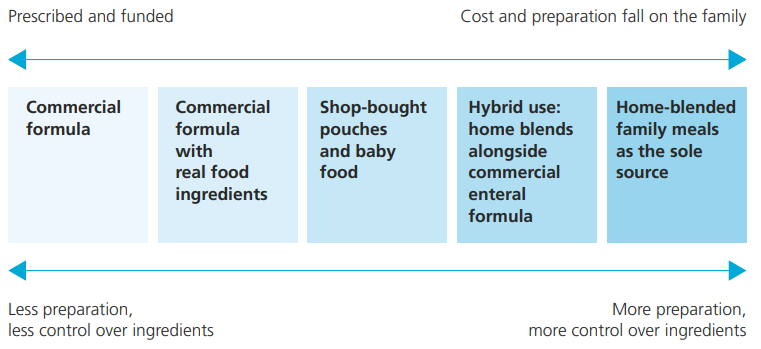
The balance may shift, with how busy life is, with a hospital admission or a change of setting. Many people use more than one approach at once; hybrid use is common. The right position is the one the person and the people preparing the blend can sustain.
Approaches compared
| Approach | What it is | What it offers | What to consider |
|---|---|---|---|
| Traditional commercial enteral formula | A nutritionally complete formula designed for use with enteral feeding tubes, prescribed and funded, with a fixed nutrient content and viscosity. | Known nutritional content. No preparation required. Usually supported by an enteral feeding contract, with pumps, ancillaries and industry nursing support. | Some people do not tolerate it well. Offers no food-based or social benefit. The uniformity can be a negative as well as a positive. |
| Commercial formula with real food ingredients | Commercial enteral formula in which some or all of the nutrition comes from recognisable food ingredients. | Fixed specification and ready to give. Reported to reduce reflux, retching and vomiting and to improve bowel habit in some people. | Not a substitute for a person’s choice to use home blends. Availability and prescribing vary between areas. |
| Shop-bought pouches and baby food | Ambient pouches, smoothies and stage 1 baby food, thinned to consistency with formula, milk or water. | Allows a trial without buying a blender. Consistent texture. Portable, so useful for travel and for settings. | Not nutritionally complete long term. Prepackaged baby food may be higher in sugar and salt than a home blend. A short-term or occasional option. |
| Hybrid use | Home blends used alongside commercial enteral formula, in any proportion: a small amount, an even split, or most of the day’s intake. | Keeps the benefits of blends while easing the workload. Commercial enteral formula can be the liquid base, the overnight feed, or if tolerated, given in settings where blends cannot practically be prepared. | Two regimens to plan and monitor. The balance often shifts with circumstances, which is expected. |
| Home-blended family meals | Everyday household food, blended meal by meal or in batches. | Shares the family’s food and mealtimes. Full control over ingredients and cultural and dietary requirements. | Nutritional content depends wholly on the food choices made. Greatest demands on time, equipment, planning and food safety. Cost is not funded. |
Preparation methods, whichever approach is used
| Method | What it offers | What to consider |
|---|---|---|
| Family meals | The tube-fed person eats what the household eats, at the same time. Least storage, least planning, freshest food. | Preparation several times a day. Needs a blender available at each meal, including away from home. |
| Individual meals | The tube-fed person has their own recipes due to allergies or a therapeutic diet. | The person preparing the blend has to cook a second meal which is more time consuming and costly. Watch for over-reliance on a limited number of recipes or food ingredients. |
| Batch blending | Blends made in advance, refrigerated for up to 48 hours or frozen for one to three months, then defrosted in the fridge. Frees time on busy days. | Needs fridge and freezer space, labelling and a food thermometer. Freezing and thawing reduce viscosity. Storage limits (Part 7) apply. |