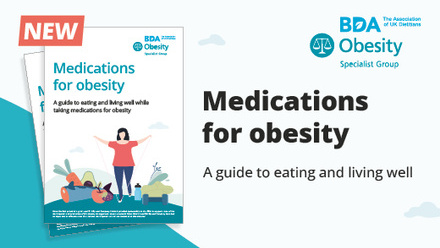
The BDA Obesity Specialist Group (OSG) has been developing a suite of dietary resources aimed at supporting individuals taking medications for obesity.
The use of medications for obesity has expanded rapidly across the UK, with around 3.4 million adults in England now meeting eligibility criteria.
As prescribing increases across NHS and private settings, a significant gap emerged: the absence of credible, evidence‑based dietary resources to support people using these medications. High-quality nutrition care is essential to optimise outcomes and minimise risks such as inadequate protein intake, micronutrient deficiencies, gastrointestinal complications and loss of fat-free mass. Growing demand from dietitians across care settings highlighted the urgent need for consistent, practical dietary guidance. This prompted the Obesity Specialist Group (OSG) to support the development of freely available, co-produced nutritional resources to support safe and equitable use of medication for obesity.
The term ‘medications for obesity’ is a covering term used for medications such as GLP-1s, GLP-1 receptor agonists, weight-loss medications, incretin therapy and in the media sometimes known as ‘skinny jabs’. The main brand names in the UK include Mounjaro, Saxenda, and Wegovy. These new resources are freely available to patients, carers and healthcare professionals, via the BDA website.
The primary generic resource offers guidance on nutrition and diet, emphasising the significance of physical activity and strengthening exercises. Additionally, it provides strategies for managing GI side effects and explores the concept of ‘food noise’, while underlining the need for sustainable, long-term lifestyle and behavioural changes.
Alongside the main generic resource, there are four ‘bolt-ons’. Three of these shorter, additional resources offer tailored information to support patients living with kidney disease, cancer and severe mental illness, including eating disorders. The fourth focuses specifically on enabling long-term behaviour change.
Background
The use of medications to manage obesity has been rising steadily in the UK, across both NHS and private healthcare sectors, with some estimates suggesting that 90% of people taking medications for obesity source these privately.
In 2025, the OSG saw a gap in credible and reliable dietary guidance available for individuals using these medications. In response, the OSG and the BDA sought funding from Novo Nordisk and Eli Lilly to produce resources to support people taking medications for obesity. The commission to develop the resources was awarded to a writing development team at AppleTree Healthy Lifestyle Consultancy. Novo Nordisk and Eli Lilly and Company have had no input into or influence over the creation, development or content contained in the resources. The development work took place from October 2025 to April 2026.
Development process
The project began with a rapid review of current evidence regarding dietary advice for people on medications for obesity. The insights from this review then informed discussions during the initial series of patient advocates’ and dietitians’ workshops.
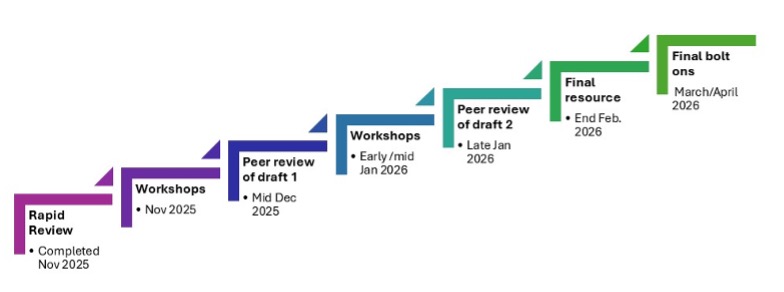
A first draft of the generic resource was then created and circulated for peer and patient review. Feedback gathered from these reviews was incorporated into a second draft. This revised version underwent further scrutiny through two additional workshops and a wider round of peer and patient review. At the same time, collaboration was initiated with the Renal, Oncology and Mental Health Specialist Groups within the BDA to develop condition-specific supplementary resources, and with the British Psychology Society (BPS) for collaboration on the long-term behaviour change bolt-on. See Figure 1 for an overview of the development process.
Key findings and collaborative input
Data was extracted from 15 papers.1–15 Of the 15 papers data was extracted from, 14 were from the United States and one7 was from a UK group. Highlighted key areas from the rapid review included:
- High protein intake should be recommended of high-quality protein foods, including plant-based sources
- The most common recommendation for protein intake was 1.2–1.5g pro/kg/day
- Nutrient-dense foods should be encouraged
- Fibre-containing foods should be encouraged
- Vitamin and mineral supplementation should be based on monitoring of blood levels, while some papers suggested this for all
- 1.5–2l of fluid per day should be recommended
- Small, frequent meals may help with GI side effects, particularly nausea
- Avoiding sugary, fizzy juices, alcohol and caffeine drinks may help with GI side effects
- Dose alteration was considered an effective strategy in easing GI side effects
- Physical activity, in particular resistance exercise (together with high protein intake), is important to reduce muscle and lean body losses
The first-round focus groups were attended by 22 dietitians and 15 patient advocates. Discussion was focused on questions that emerged from the rapid review. The main take-home messages from the four workshops were:
- Accessible reading style – aiming for a reading age of nine years
- Discuss food noise, sarcopenia and behaviour change
- Talk in terms of nutrients, foods and meals
- Manage expectations of use of the medications for obesity
- Emphasise regular eating and nutrient-dense foods
- How to manage GI side effects
- Mention fibre and fluids
- Include resistance activities
The dietitians were keen to see:
- Expectations and responsibilities of ‘prescriber’s’ role
- Suggested meal distribution of 50% vegetables, 25% carbohydrates and 25% protein
- Charting of progress
While the patients wished the resource to mention:
- Holidays and special occasions
- Hormonal changes
- Shopping and eating out
The subsequent draft one was distributed via email to 49 potential reviewers, with responses received from 36 individuals or organisations, which informed the next iteration. The second round of workshops included 20 dietitians and six patient advocates, further refining the resource. The revised draft was then sent to 60 potential reviewers for broader consultation, resulting in 20 responses.
A guide to eating and living well while taking medications for obesity
The guide opens with exploring who would benefit from the resource and defines what is meant by the term ‘medications for obesity’. A short description follows, of how medications for obesity work to reduce hunger and make people feel full after eating.
There is an important section on details for people to consider before taking the medications, such as possible interaction with other medicines, pregnancy, breastfeeding and HRT, disordered eating and future surgery. There are messages throughout the guide to speak to a healthcare team and discuss any concerns with the medication’s prescriber.
What encompasses a healthy lifestyle, the importance of energy-dense foods and a balanced diet are explored. A suggested meal balance of 50% fruits and vegetables, 25% high-quality protein and 25% carbohydrates is suggested – see Figure 2. The concept of ‘food noise’ is explored, as are potential GI side effects with possible suggestions to help reduce these.
The importance of movement, physical activity and in particular resistance activities is explored, in relationship to muscle loss and sarcopenic obesity, with simple suggestions given for activities.
The guide finishes off with touching on the importance of long-term behaviour change and support when making these changes. This information is further underpinned in the separate additional resource on behaviour change, which was written in collaboration with the BPS.
Links to suggested meals and to other relevant web pages are signposted in the resource, such as physical activity, sleep hygiene, portion sizing and relaxation.
Areas of debate
With such a large number of reviewers and workshop attendees, several issues needed to be debated and considered. For these, the resource oversight group took the final decisions. One key discussion was around the term used to describe the medications.
A decision was made to ask the patient advocates and their majority decision was to use the terms ‘medications for obesity’ and ‘obesity management’. Another area influenced by the patient advocates was the final positioning of the section on food noise. Indeed, this was a significant issue for the patients.
From a dietetic clinical point of view, it was felt that as a generic resource openly available to the public, the dietary advice needed to be general and straightforward. Therefore, there is no discussion within the resource on specific grams of protein, use of liquid meal replacements or a blanket suggestion on taking vitamin and mineral supplements. For all these specific dietary points, the resource recommends seeking advice from a registered dietitian.
Resource accessibility
From the outset, the OSG were explicit in wanting the resources to be widely accessible. To this end, the main generic resource is currently being translated into Polish, Urdu, Arabic and Spanish, while being made accessible for those with sight impairment (through the Royal National Institute of Blind People) and hearing impairment (through Action Deafness). In addition, the main generic resource and all bolt-ons are being translated into Welsh. When these resources are ready, they will be available on the same BDA webpage as the other resources.
References
- Al-Najim W, Raposo A, BinMowyna MN, le Roux CW. Unintended Consequences of Obesity Pharmacotherapy: A Nutritional Approach to Ensuring Better Patient Outcomes. Nutrients . Multidisciplinary Digital Publishing Institute (MDPI); 2025. doi:10.3390/nu17111934 PubMed PMID: 40507203.
- Almandoz JP, Wadden TA, Tewksbury C, Apovian CM, Fitch A, Ard JD, et al. Nutritional considerations with anti-obesity medications. Obesity. John Wiley and Sons Inc; 2024. p. 1613–31. doi:10.1002/oby.24067 PubMed PMID: 38853526.
- Ben-Porat T, Sherf-Dagan S, C.t. M, Miner CJ, Buch A. Nutritional Challenges of Incretin-Based Obesity Management Medications: Implications for Clinical Practice. Advances in Nutrition. 2025 Sep;100522. doi:10.1016/j.advnut.2025.100522 PubMed PMID: 40975496.
- Gigliotti L, Warshaw H, Evert A, Dawkins C, Schwartz J, Susie C, et al. Incretin-Based Therapies and Lifestyle Interventions: The Evolving Role of Registered Dietitian Nutritionists in Obesity Care. J Acad Nutr Diet. 2025 Mar 1;125(3):408–21. doi:10.1016/j. jand.2024.10.023 PubMed PMID: 39521378.
- Memel Z, Gold SL, Pearlman M, Muratore A, Martindale R. Impact of GLP- 1 Receptor Agonist Therapy in Patients High Risk for Sarcopenia. Current Nutrition Reports. Springer; 2025. doi:10.1007/s13668-025-00649-w PubMed PMID: 40289060.
- Chavez AM, Carrasco Barria R, Leon-Sanz M. Nutrition support whilst on glucagon-like peptide-1 based therapy. Is it necessary? Current Opinion in Clinical Nutrition and Metabolic Care. Lippincott Williams and Wilkins; 2025. p. 351–7. doi:10.1097/MCO.0000000000001130 PubMed PMID: 40401903.
- Brown A, Mellor D, Makaronidis J, Shuttlewood E, Miras AD, Pournaras DJ. “From evidence to practice” – Insights from the multidisciplinary team on the optimal integration of GLP-1 receptor agonists in obesity management services. Nutrition Bulletin. John Wiley and Sons Inc; 2024. p. 257–63. doi:10.1111/nbu.12700 PubMed PMID: 39136338.
- Mozaffarian D, Agarwal M, Aggarwal M, Alexander L, Apovian CM, Bindlish S, et al. Nutritional priorities to support GLP-1 therapy for obesity: A joint Advisory from the American College of Lifestyle Medicine, the American Society for Nutrition, the Obesity Medicine Association, and The Obesity Society. Obesity. 2025 Aug 1;33(8):1475–503. doi:10.1002/oby.24336
- Thomsen RW, Mailhac A, L.hde JB, Potteg.rd A. Real-world evidence on the utilization, clinical and comparative effectiveness, and adverse effects of newer GLP-1RA-based weightloss therapies. Diabetes Obes Metab. 2025 Apr 1;27(S2):66–88.doi:10.1111/dom.16364 PubMed PMID: 40196933.
- Dash S. Opportunities to optimize lifestyle interventions in combination with glucagonlike peptide-1-based therapy. Diabetes Obes Metab. 2024 Sep 1;26(S4):3–15. doi:10.1111/dom.15829 PubMed PMID: 39157881.
- Mehrtash F, Dushay J, Manson JE. I Am Taking a GLP-1 Weight-Loss Medication—What Should I Know? JAMA Intern Med. 2025 Sep 1. doi:10.1001/jamainternmed.2025.1133 PubMed PMID: 40658429.
- Mehrtash F, Dushay J, Manson JE. Integrating Diet and Physical Activity When Prescribing GLP-1s—Lifestyle Factors Remain Crucial. JAMA Intern Med. 2025 Sep 1. doi:10.1001/jamainternmed.2025.1794 PubMed PMID: 40658434.
- Fitch A, Gigliotti L, Bays HE. Application of nutrition interventions with GLP-1 based therapies: A narrative review of the challenges and solutions. Obesity Pillars. Elsevier B.V.; 2025. doi:10.1016/j.obpill.2025.100205
- Gentinetta S, Sottotetti F, Manuelli M, Cena H. Dietary Recommendations for the Management of Gastrointestinal Symptoms in Patients Treated with GLP-1 Receptor Agonist. Diabetes, Metabolic Syndrome and Obesity . 2024;17:4817–24. doi:10.2147/DMSO.S494919
- Gorgojo-Mart.nez JJ, Mezquita- Raya P, Carretero-G.mez J, Castro A, Cebri.n-Cuenca A, de Torres-S.nchez A, et al. Clinical Recommendations to Manage Gastrointestinal Adverse Events in Patients Treated with Glp-1 Receptor Agonists: A Multidisciplinary Expert Consensus. J Clin Med. 2023 Jan 1;12(1). doi:10.3390/jcm12010145