Dietitians within a specialist recovery service in Glasgow are thought to be the only dietetic team in the UK with a specific remit to support those with drug and alcohol addictions.
The Alcohol and Drug Recovery Service (ADRS) in Glasgow has evolved over more than 20 years into a unique four-tier service supporting those impacted by drug and alcohol addictions.
Tier 1 services include recovery communities, hubs and cafes. Tier 2 services include GPs and third-sector organisations, with Tier 3 services managed through community ADRS care and treatment services. Tier 4 services include two 15-bed inpatient wards, dietetics, occupational therapy, alcohol-related brain damage (ARBD), crisis outreach, acute hospital liaison, an enhanced drug treatment service and the new safer drug consumption facility ‘the Thistle’.
It is known that people with addictions to alcohol and drugs often have poor nutritional intakes and increased nutritional requirements.1,2 Malabsorption and complications relating to alcohol and drug use are common in this population, risking malnutrition and poor quality of life.
Chaotic lifestyles, social stressors, stigma, isolation and trauma create environments where food may not be prioritised or readily available. The associated physical and mental health conditions and lack of trust in services create further barriers to receiving traditional healthcare. This has led to health inequalities and unfairness in accessing the care they need.
As far as we are aware, we are the only dietetic team within the UK with a specific remit to support those with drug and alcohol addictions. In other locations, those with addictions are usually seen within general mental health, homeless or complex needs services. Our roles as specialist addictions dietitians vary widely as we consider our service users’ use of drugs and alcohol alongside co-existing physical health, mental health and socio-economic challenges within a specialist team.
Who are the ADRS dietitians?
We are a three whole-time-equivalent dietetic team with one dietitian covering community, one dietitian covering the inpatient detox wards (currently two dietitians who job share) and one dietetic team lead.
We advise our service users on a range of conditions including malnutrition, liver disease, alcohol-related brain damage, chronic pancreatitis, diabetes (types 1, 2 and 3c) and their resulting malnutrition, re-feeding risk and vitamin deficiencies. Our service users often have co-existing mental health conditions that have been a result of or have contributed to their alcohol or drug dependence.
Dietitians working within ADRS provide a service to inpatient and community service users under Glasgow City ADRS and the Alcohol-Related Brain Damage service. Service users are referred by ward staff, their community ADRS worker or another health professional. The dietitian completes an assessment and provides a dietetic plan along with the person and their team. Nutrition advice is delivered on an individual basis and via ward nutrition groups.
Training in first-line nutrition advice is provided for other health professionals within the ADRS team in community settings.
Our aims
Our aim was to maximise dietetic reach across all four tiers of the service, using our unique, limited dietetic resource.
We aimed to develop our service to reach a service user group that faces significant barriers to accessing healthcare. We therefore had to take a creative, trauma-informed, person-centred and flexible approach in order to meet people where they are in terms of location and the stage of their recovery and substance use journey.
Areas of service development
The team worked on the following workstreams to improve the quality and numbers of service users accessing dietetics:
- Dietetic input to the inpatient wards
- Dietetic input to those in the community setting
- Dietetic input within recovery communities
- Staff training
- Development of addiction-specific nutrition resources, available from nhsggc.scot/yourhealth/right-care-right-place/addictions/adrsnutrition-leaflets/
- Development of structured team support and development
1. Dietetic input to the inpatient wards
On average, there are 32 admissions over the two wards per month, and 20–25 of these are referred to dietetics based on MUST score, initial nutrition screen and clinical judgement of ward staff. Service users on the ward are seen by dietetics on average twice during a two-week detox admission.
We recognised that evidence-based nutrition information would benefit any of our service users on the ward. It is common for addiction support interventions to exist within group settings, and we therefore implemented weekly nutrition education groups on each ward. These groups were open to anyone on the ward and covered aspects of nutrition such as supporting weight gain, weight management, thiamine, energy and the various food groups. The groups also allowed for self-referral on to dietetics and the opportunity to ask any nutrition questions that they had. These groups were named ‘Recovery Bites’, with the aim of linking with other service initiatives, such as the new ADRS nutrition resources and improving recognition of our services. A nutrition noticeboard on each ward further promoted the ward groups.
For service users requiring input beyond the inpatient setting, we initiated phone follow-up after discharge. This allowed for improved continuity between hospital and home, maintained consistency with the dietitian who had established rapport and reduced dietetic workload within the stretched community setting.
2. Dietetic input to those in the community setting
There are around 6,000 service users accessing ADRS services across Glasgow City. Community service users are referred to us via any member of the ADRS team or other health professional involved in their care.
Previously, community appointments were scheduled via phone. This had largely been due to the service starting during the COVID pandemic. However, it was identified that a more person-centred assessment could be conducted face-to-face. Each service user within ADRS has a designated worker, and we started to consult service users with their workers in locations suitable for the service user and clinicians (in local clinics, in their homes or in another identified place where the person would feel comfortable). A designated dietitian re-started cover to the specialist ADBD service, as it was identified that this service would benefit from consistency.
We increased awareness of dietetics within the wider team through attending multidisciplinary team meetings across the city and providing staff training in first-line dietary advice and how to refer. We widened our referral criteria to enable any service user within ADRS and living within Glasgow City or currently on our detox inpatient wards to be able to access our service. As many of our service users are often discharged from other specialist services due to missing appointments, we offer some input to a range of conditions and encourage attendance with their specialist medical teams.
We have a high tolerance to missed appointments as part of our trauma-informed approach. We appreciate the barriers that our service users face and the difficulties that exist for them to reach appointments on time. An hour is given per community appointment, with acknowledgement that many will arrive late. Reminders are sent ahead of appointments, we liaise with the person’s worker and we will offer repeat appointments where needed. Time waiting for service users is used productively for service development and sharing of knowledge between workers and dietitians.
3. Dietetic input within recovery communities
Adequate nutrition is an important factor to support health when using drugs and alcohol and throughout a person’s recovery journey.
However, dietetic resource had been prioritised to those that were at greatest nutritional risk. A gap was identified where those in recovery would benefit from dietetic input at a time where they are abstinent, motivation is high, relapse is common but healthcare input is less frequent.
There are three recovery communities across the city – in the northwest, northeast and south of Glasgow – that are run by volunteers with lived experience of addiction, supporting others affected by addiction. We set up training in nutrition advice (helping people know how to gain weight, lose weight and manage addiction-related symptoms) for the volunteers. This work was co-produced together with the volunteers to ensure it met their needs and now runs annually in each area as three one-hour sessions, held a month apart.
We contribute to the monthly recovery community newsletters, offering nutrition tips and information tailored to anyone affected by addiction. We have a dietetic presence at addiction-specific meetings and health promotion events across the city.
4. Staff training
Staff training was developed for all ADRS workers in first-line nutrition advice. This enabled others to be able to provide ‘food first’ nutrition advice confidently while waiting for a dietetic appointment, and would sometimes allow for nutrition improvement without requiring dietetic resource or oral supplements.
5. Development of addiction-specific nutrition resources
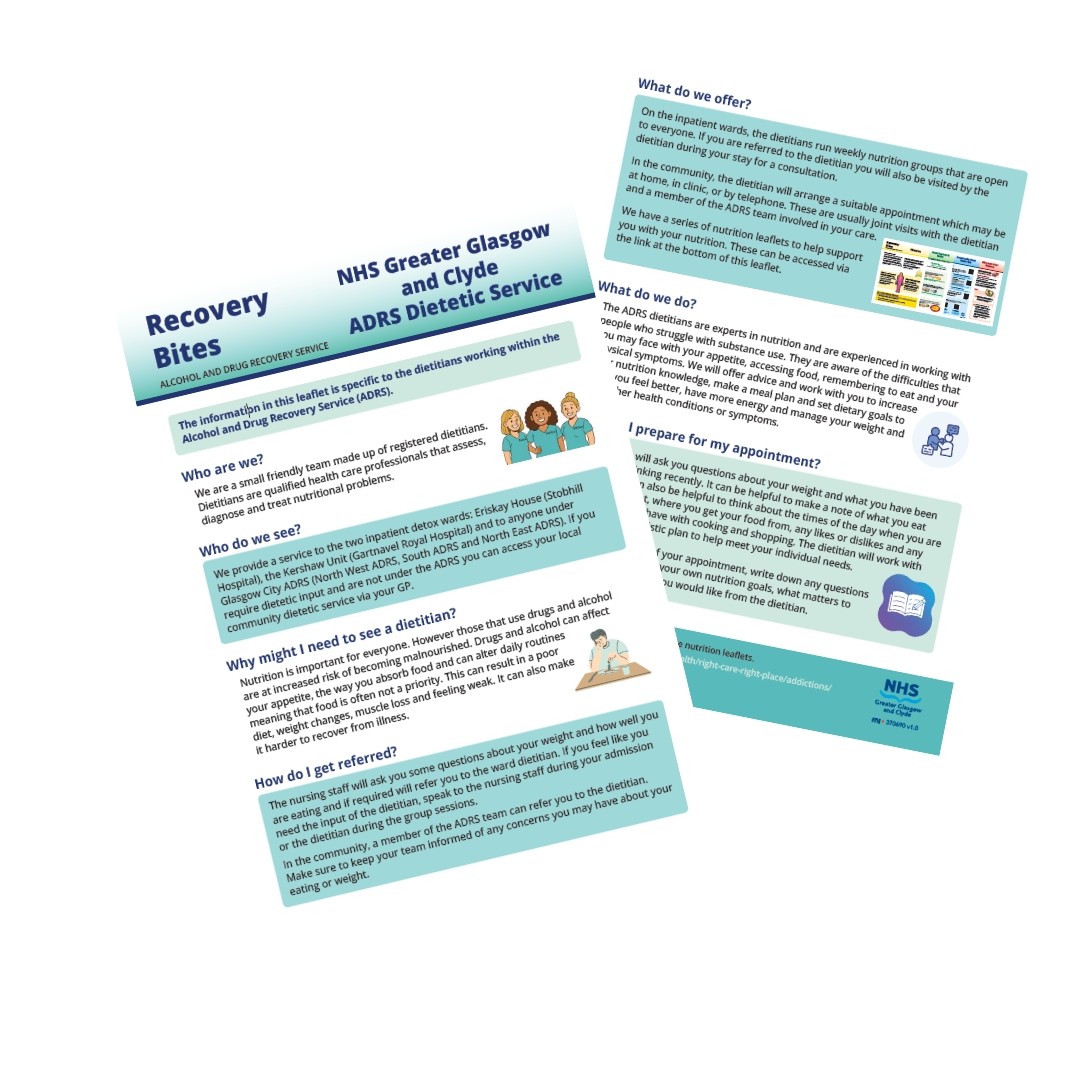
Generic nutrition resources often fall short for our service user group. Many include advice to moderate alcohol intake, making them unsuitable for individuals where abstinence is recommended. Additionally, they frequently overlook the unique barriers to nutrition that our service users face. In response, our team developed resources that directly address the specific challenges experienced by our service user group, improving fairness in accessing healthcare for those with addictions.
We named the series of resources ‘Recovery Bites’ to link with the ward nutrition groups of the same name. These were co-designed by the dietetic team and service users. Recovery Bites resources address various nutrition-related challenges, such as Store Cupboard Items, Community Food Resources, Thiamine, Liver Disease, Alcohol-Related Brain Damage and Quick and Easy Meal Ideas. The resources are available on the NHS Greater Glasgow and Clyde website under the Alcohol and Drug Recovery Service section.
6. Development of structured team support and development
With great aspirations to improve our service came many changes to how we were planning to work. A robust supervision structure of weekly one-to-one sessions with the team lead, monthly management supervision and monthly clinical supervision was created and enabled each person to feel supported and maintain momentum with the various agreed work streams. A new meeting initiative called ‘Balanced Bites’ was created and held every six months with the aim of bringing the dietetic team together, celebrating successes as individuals and professionals and learning from each other.
Our impact
Our team have been able to provide a trauma-informed service designed around our service users, meeting people where they are in terms of stage of recovery and location.
The total number of service users receiving dietetic input trebled in the inpatient ward setting between July 2024 and May 2026. There was a 47% increase in inpatient dietetic assessments between July 2024 and May 2026. In a service user evaluation questionnaire following attendance at the ward groups, 89% of attendees felt that their nutrition knowledge had improved, with 78% saying they would make dietary changes as a result of the session. One quote from a service user attending a ward nutrition group was: “I thought my knowledge was good. But this has helped a lot. I learned a lot.”
Community referrals to dietetics remained stable but by April 2026, 85% were conducted face-to-face rather than by phone as had been the case entirely in 2024. The attendance rate had also increased from 45% in July 2024, to 73% in July 2025 and 65% in April 2026.
Evaluations from staff training across ADRS, ARBD and the recovery communities have been positive and have enabled accurate nutrition messages to be shared to those accessing services, without the need for extra dietetic resource. Over 200 people have been trained in first line nutrition advice between November 2024 and June 2026. Feedback via questionnaire following the training included: “Really enjoyed it and found it really helpful, could help my clients and family members, thank you” and “I totally understand the importance of this training.”
Resources have been welcomed across service user and staff groups. These resources are accessible to anyone and are the first of their kind. As of 30 June 2026, over 2,000 resources that have been live on our website since March–November 2025 have been downloaded. One opinion from a service user who was part of the resource development process was: “Not scary – most information you get tries to scare you.”
The ADRS dietitians have remained happy, fulfilled and motivated in their roles as evidenced during supervision meetings, Balanced Bites events and ‘iMatter’ feedback, enabling this work to continue. One quote that sums up the feeling within our team after a recent Balanced Bites session was: “Everyone works and contributes to Balanced Bites – a great mix of innovation, shared knowledge and empowerment.”
Our success has also been recognised by our NHS Scotland Board. We were all so proud this summer to win the Team of the Year 2026 Award at the NHS Greater Glasgow and Clyde AHP Awards.
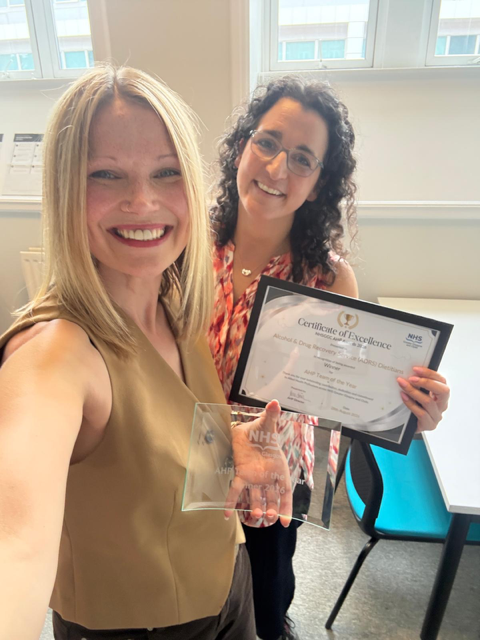
The service was named Team of the Year 2026 at the NHS Greater Glasgow and Clyde AHP awards.
The future
We are a continually evolving service, adapting to our service users’ needs. We have several projects in our minds to explore over the next few years.
- Developing an addictions-specific dietetic interest group. Feel free to register interest by emailing our team lead Nathalie Jones at [email protected]
- Improving the use of our nutrition noticeboards
- An audit of weight monitoring within ARBD-supported services
- An audit of mid-upper arm circumference and BMI among our inpatients
- Integrating dietetic support into our Thistle service, the new safer drug consumption facility
- Work on measuring outcomes for our service
- Improving links between the inpatient and community recovery journey with a multi-disciplinary ‘recovery passport’
- Sharing our service and learning via a strategic knowledge exchange workplan
References
- Mahboub N, Rizk R, Karavetian M, de Vries N. Nutritional status and eating habits of people who use drugs and/or are undergoing treatment for recovery: a narrative review. Nutrition Reviews [internet]. 2020 [cited 22.6.26]. 79(6):627–635. Available from: https://academic.oup.com/nutritionreviews/article/79/6/627/5911317
- Clinical guidelines for alcohol treatment – 16. Alcohol care in acute hospitals – Guidance – GOV.UK [Internet]. 2025 [cited 22.6.26]. Available from: https://www.gov.uk/guidance/clinical-guidelines-for-alcohol-treatment/16-alcohol-care-in-acute-hospitals