Louise Kirkham talks to Tanya Haffner and Amy Roach about the Plants First Healthcare Coalition.
Our food system plays a critical role in the wellbeing of people and planet. It is one of the largest sectors in any economy. It is a major source of greenhouse gas emissions and environmental destruction. The mainstream food system is directly responsible for a host of diet-related diseases that threaten to bankrupt national health services.1
Crucially, our food system is now widely recognised as having the power to heal, nourish, bring people together and transform healthcare and society.1,2,3 As our understanding of the links between food, nutrition, health and sustainability continues to grow, healthcare settings are increasingly embracing food as a powerful tool for better and multiple outcomes.4,5,6,7,8 The NHS is committed to improving the quality of food in hospitals, not just as a policy but as a core pillar of patient care, supporting recovery with a shift in focus towards prevention and making food more sustainable.7,8,9
The BDA sees healthcare catering as a pivotal link in public and planetary health9,12 and dietitians recognise plant-rich diets as a priority in healthcare.6,13
The BDA, the BDA Food Services Specialist Group and the BDA Sustainable Diets Group have collaborated to update resources and guidance to reflect the shared ambition to deliver an evidence-based approach where nutritious and sustainable foods go hand in hand.6,13
This Sustainable September, the BDA – along with both specialist groups – will host a webinar to launch the new BDA position paper, Reducing Carbon in NHS Patient Menus,6 sharing and discussing the findings with members. The webinar will be advertised with details of how to attend on our Instagram and LinkedIn pages, while group members will have links in their newsletters. A joint in-person meeting is also planned for November – watch out for email announcements via both specialist groups.
In the December–January issue of Dietetics Today, we will include a report from the webinar and in-person event and, over the coming year, we will include interviews and case studies from those delivering on the ground.
This month, we include a recent interview with dietitians Tanya Haffner and Amy Roach, who are supporting local trusts and hospitals to pioneer sustainable food systems in the NHS with the advent of a new civil society not-for-profit coalition called the Plants First Healthcare Coalition (PFHC).
Can you tell us about your roles?
Tanya: I am a dietitian and Chair of the BDA Sustainable Diets Group and CEO at MyNutriWeb – the nutrition education hub, which is a founding member of the PFHC.
Amy: I am a dietitian and Consultation Officer at the BDA Sustainable Diets Group, and I am UK Healthcare Manager at Greener by Default, which is a founding member of the Plants First Healthcare Coalition.
Can you tell us about the PFHC?
Tanya: The PFHC was created to help support and accelerate the transformation of food in healthcare. By bringing together experts in healthcare, dietetics, sustainability, catering and culinary education, the PFHC supports hospitals, catering suppliers and healthcare organisations across the UK to create food cultures where delicious, nutritious and culturally diverse plant-rich meals become a celebrated and accessible part of everyday care.
This is not about removing choice. Full choice remains. It is about rebalancing food provision so that nutritious plant-rich meals become a much more accessible, inclusive, attractive and normal part of healthcare food. Plant-rich menus are inclusive and nutritionally appropriate, satisfying, culturally inclusive, affordable and enjoyable, meeting the needs of patients who may have poor appetites, increased nutritional requirements, swallowing difficulties, allergies or other clinical needs.
That is why dietetic involvement is so important and why we work closely with catering teams, including food service dietitians, who play a crucial role. We have never been more excited about the role of food service dietitians and can see the importance and need for them increasing in our profession.
The coalition is a not-for-profit partnership of five founding organisations: Greener by Default, ProVeg UK, Plant-Based Health Professionals UK, Real Zero and MyNutriWeb. Together, the coalition brings expertise in dietetics, nutrition, behaviour change, menu development, culinary training, healthcare education, sustainability and communications. Our shared mission is simple: to provide the support, guidance and expertise needed for healthcare settings to successfully adopt a delicious, nutritious, sustainable plant-rich food culture that is good for people and the planet.
What is the Coalition’s overall vision and current priorities?
Amy: Our vision is for plant-rich meals – prioritising plant-based sources of protein – to become an integral part of hospital food culture and be recognised as the most sustainable, nutritious, health-supporting and inclusive choice, while ensuring that full choice remains on menus. We believe that everyone involved in healthcare, from catering teams and clinicians to estates staff and senior leaders, has a role to play in creating this healthcare environment that supports both human and planetary health.
The coalition’s work is driven by four priorities: reducing human suffering and health inequalities; nurturing a food culture that supports health and prevents disease; helping transform the food system so that it operates within planetary boundaries; and ensuring the long-term sustainability of the NHS. These goals are deeply interconnected. The same dietary patterns that support better health are often those that have the lowest environmental impact.
A growing body of evidence demonstrates that diets rich in whole plant foods can help prevent and manage many of the chronic diseases that place the greatest burden on individuals and healthcare systems. At the same time, plant-rich meals require fewer natural resources and generate substantially lower greenhouse gas emissions than meals centred on animal products. In helping to create a better healthcare food system, there is a huge opportunity to link in with local food supply chains to help build stronger, more resilient local economies and greater food security. For healthcare organisations seeking to improve patient outcomes while meeting sustainability commitments, food presents a unique opportunity for positive change. This is an exciting culinary and dietetic challenge for our profession.
Can you elaborate on your day-to-day approach and work?
Tanya: Our approach is practical, inclusive and rooted in collaboration. We help healthcare providers make plant-rich options more visible, appealing, accessible and suitable for local population needs and desires. Through menu audits, recipe development, chef training, staff education and pilot programmes, we work alongside catering teams to create changes that are desirable, achievable, evidence-based and tailored to local needs, while meeting all standards.
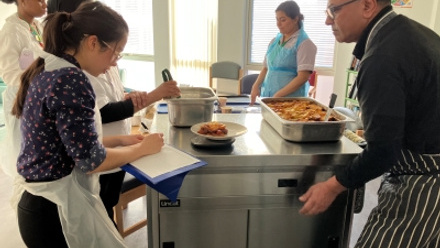
Chefs, catering teams and dietetic professionals are central to this transformation. One of our key objectives is to help build the skills and confidence needed to create exceptional plant-rich dishes that staff and patients genuinely enjoy. Plant-based culinary training skills are not included in traditional chef training – there is a huge need for this. We support teams to work creatively with plant proteins, develop recipes that meet NHS and BDA nutrition and hydration standards, consider different clinical patient needs and stages of life and local food preferences and demonstrate that sustainable food can be both delicious and cost-effective.
Do you have key targets, and what have you achieved to date?
Amy: Over the next five years, the coalition aims to increase the quality, quantity and uptake of low-carbon plant-based meals in hospitals, support culinary training, expand plant-rich recipe resources and help embed positive food cultures throughout healthcare settings.
The coalition has begun building a community of NHS and food-sector leaders committed to advancing plant-rich healthcare food. Through meetings, workshops and direct engagement, we have:
- Brought together NHS catering teams, dietitians, chefs, suppliers and trust and sustainability leaders
- Shared examples of plant-rich menu innovation and implementation
- Explored the practical barriers affecting procurement, production, nutrition, uptake and reporting
- Started building greater alignment around meaningful, measurable ambitions
- Encouraged organisations to move from isolated dishes and short-term initiatives towards strategic, organisation-wide change
- Highlighted the need for consistent data and reporting so that progress can be understood and shared Created a forum in which suppliers and NHS teams can work together on product availability, recipe development and implementation
This work is helping to develop the foundations for a shared roadmap across healthcare.
The coalition’s approach is already delivering measurable results. At the Royal National Orthopaedic Hospital, increasing the availability and visibility of plant-rich meals in the staff canteen shifted more than 3,000 meals from animal-based to plant-based options over a three-month period, reducing average meat consumption by 33% and lowering food-related greenhouse gas emissions by 40%, while meeting standards and maintaining high levels of staff satisfaction. Across 36 Nuffield Health hospitals, a three-month plant-forward menu initiative reduced meat served per patient by 14% and cut catering-related emissions by 22%, again with satisfaction levels maintained at 90%. These examples demonstrate that serving more plant-rich food can improve sustainability and nutrition and reduce costs – and importantly do so without compromising patient or diner experience. The coalition is also working to generate evidence, share best practice and influence policy so that sustainable healthcare food becomes the norm rather than the exception.
I understand you have been supporting NHS England’s Recipe Bank. Can you share details?
Tanya: The coalition has developed 35 fully plant-based recipes for the NHS England’s Recipe Bank that meet NHS and BDA nutrition and hydration standards for inpatient settings, but can also be used by chefs for staff canteens. They have each been carefully tried and tested. These are soon to go live, and more recipes are in the pipeline where we are working closely with chefs, food service and sustainable dietitians and speech and language therapists where appropriate.
How can dietitians connect with the PFHC?
Amy: Our website plantsfirsthealthcare.com will list the ways that you can contact us, but it is currently under some development, so in the meantime, or anytime, please feel free to contact me at [email protected].
References
- Rockström, J., Thilsted, S. H., Willett, W. C., Gordon, L. J., Herrero, M., Hicks, C. C., Mason-D’Croz, D., Rao, N., Springmann, M., Wright, E. C., Agustina, R., Bajaj, S., Bunge, A. C., Carducci, B., Conti, C., Covic, N., Fanzo, J., Forouhi, N. G., Gibson, M. F.,. . . DeClerck, F. (2025). The EAT Lancet Commission on healthy, sustainable, and just food systems. The Lancet, 406(10512), 1625-1700. https://doi.org/10.1016/S0140-6736(25)01201-2
- Morgan K. Serving the public: The good food revolution in schools, hospitals and prisons. 2026. Manchester University Press.
- Springmann M, Clark M, Rayner M et al. The global and regional costs of healthy and sustainable dietary patterns: a modelling study. The Lancet Planetary Health, 2021; 5, e797-e807
- Health Care Without Harm. Global road map for health care decarbonization: a navigational tool for global health systems. Brussels: Health Care Without Harm; 2021.
- Centers for Medicare & Medicaid Services. QSSAM-26-03: Hospital and CAH – Hospital Nutrition Service Obligations in Light of Updated Federal Nutrition Guidelines. Baltimore (MD): CMS; 2026 Mar 30.
- British Dietetic Association. Reducing carbon in NHS patient menus. Birmingham: BDA; 2026.
- NHS England. Delivering a ‘Net Zero’ National Health Service. London: NHS England; 2020 Oct.
- NHS England. NHS Green Plan: Delivering a Net Zero National Health Service. London: NHS England; 2022.
- The Healthcare Chefs Knowledge 2 (2025) The Chefs Forum. Catherine Farinha, Red Cherry (Bristol) Ltd.
- Food in Healthcare Report: https://tinyurl.com/foodinhealthcare
- Sadler, I., Bauer, A. and Kassam, S. (2025), How Sustainable Are Hospital Menus in the United Kingdom? Identifying Untapped Potential Based on a Novel Scoring System for Plant-Based Provisions. Journal of Human Nutrition and Dietetics, 38:e70019. https://doi.org/10.1111/jhn.70019
- British Dietetic Association. Nutrition and Hydration Digest: Improving Outcomes Through Food and Beverage Services in the NHS – 3rd ed. Birmingham (UK): British Dietetic Association; 2024.
- Frances Slowie, Linda Hindle, Louise Davey-Hewins, Sarah Cooper, Clare Pettinger (2026) Allied health professions (AHP) engagement with and leadership towards actionable carbon reduction interventions to meet the NHS net zero agenda: a consensus study. BMJ Leader 2026;0:1–7. doi:10.1136/ leader-2025-001451.
- Plants First Healthcare coalition website: https://plantsfirsthealthcare.com